




Start od Animation Career-
In January 1920, Disney and Iwerks formed a short-lived company called "Iwerks-Disney Commercial Artists". However, following a rough start, Disney left temporarily to earn money at the Kansas City Film Ad Company. He was soon joined by Iwerks, who was not able to run their business alone. While working for the company, where he made commercials based on cutout animation, Disney became interested in animation and decided to become an animator. The owner of the Ad Company, A.V. Cauger, allowed him to borrow a camera from work to experiment with at home. After reading the Edwin G. Lutz book Animated Cartoons: How They Are Made, Their Origin and Development, Disney considered cel animation to be much more promising than the cutout animation he was doing for Cauger. He eventually decided to open his own animation business and recruited a fellow co-worker at the Ad Company, Fred Harman, as his first employee. Disney and Harman then started creating cartoons called Laugh-O-Grams. Disney studied Aesop's Fables as a model. The first six of the new Laugh-O-Grams were modernized fairy tales. They screened their cartoons at a local theater owned by Frank Newman, who was one of the most popular "showmen" in Kansas City.
Presented as "Newman Laugh-O-Grams", Disney's cartoons became widely popular in the Kansas City area. Through their success, he was able to acquire his own studio, also called Laugh-O-Gram, for which he hired a number of additional animators, including Fred Harman's brother Hugh Harman, Rudolf Ising, and his close friend Ubbe Iwerks. It was opened on May 18, 1922.However, studio profits were insufficient to cover the high salaries paid to employees. Unable to successfully manage money,Disney's studio became loaded with debt and wound up bankrupt, whereupon he decided to set up a studio in the movie industry's capital city, Hollywood, California.
Alice Comedies-
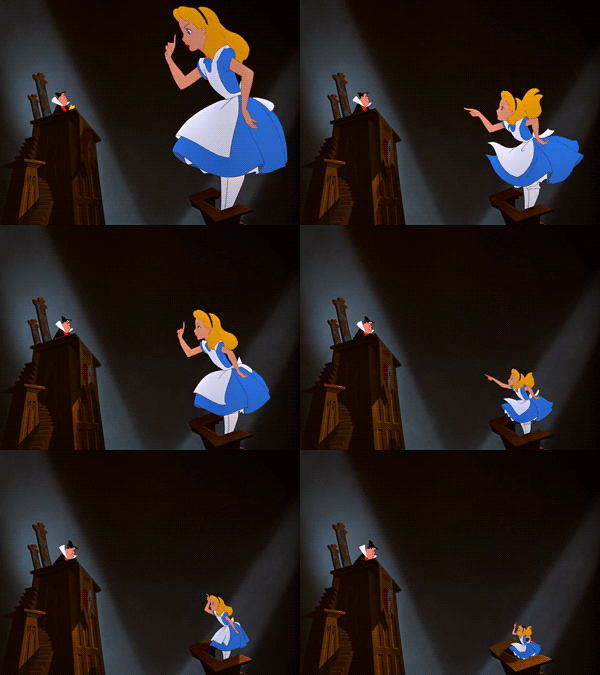
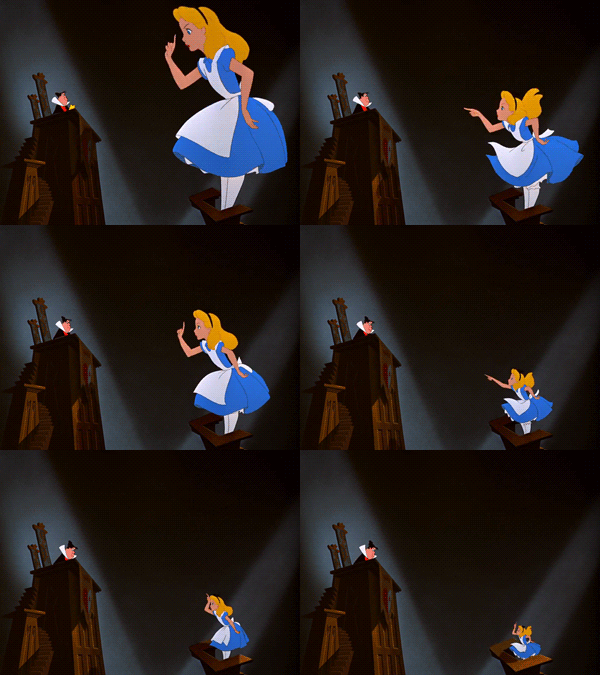
Disney and Roy needed to find a distributor for Walt's new Alice Comedies, which he had started making while in Kansas City but never got to distribute. Disney sent an unfinished print to New York distributor Margaret Winkler, who promptly wrote back to him that she was keen on a distribution deal for more live-action/animated shorts based upon Alice's Wonderland. Walt did the animation himself and directed the live-action scenes, while Roy took on the unfamiliar role of cameraman, photographing both the animation and the live action. The first of the new Alice Comedies, Alice’s Day at Sea, was delivered on December 26, 1923, and the Disney Brothers studio received their first earnings of $1,500. The new series, Alice Comedies, proved reasonably successful. It featured Virginia Davis, with other child actresses assuming the role later. By the time the series ended in 1927, it had lost popularity. Historian J.B. Kaufman said its focus was more on the animated characters rather than the live-action Alice, while its idea had exhausted itself.
Oswald the Lucky Rabbit-
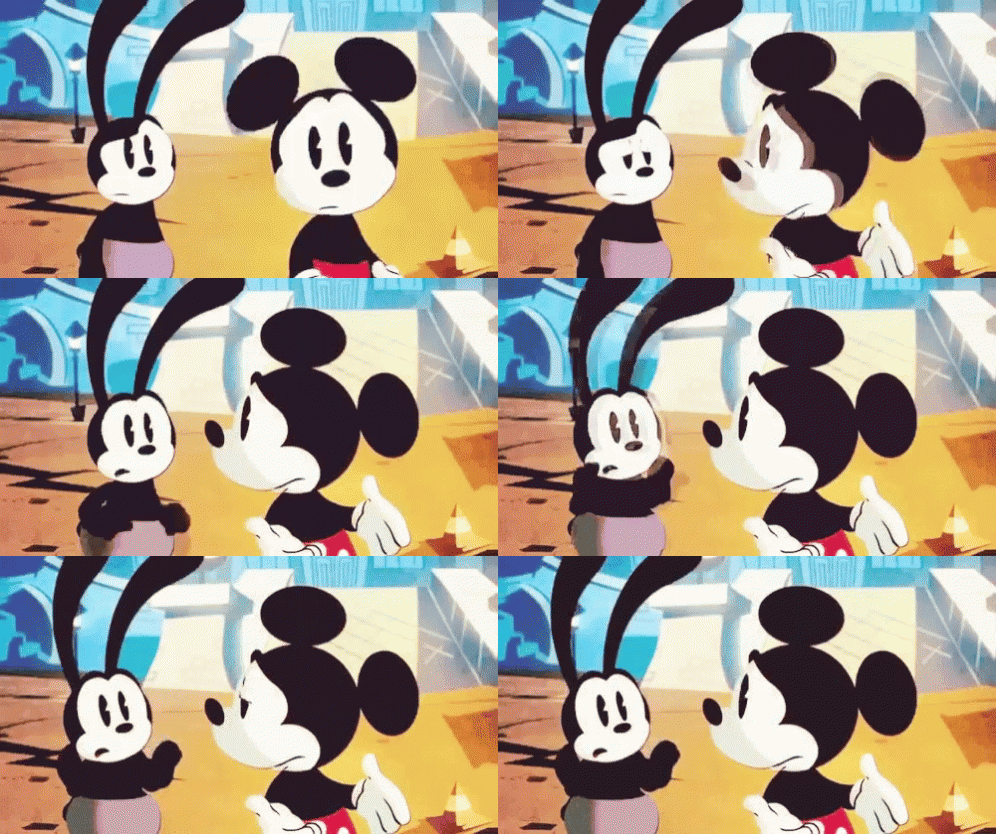
Charles Mintz ordered a new, all-animated series to be put into production for distribution through Universal Pictures. The new series, Oswald the Lucky Rabbit, was an almost instant success, receiving comments like "exceptionally clever" and "fine cartoon ingenuity". Its main character, Oswald — drawn and created by Iwerks — became a popular figure with high merchandise performance.
Disney went to New York in February 1928 to negotiate a higher fee per short. He was shocked when Mintz told him that not only did he want to reduce the fee he paid Disney per short but also that he had most of his main animators, including Harman, Ising, Maxwell, and Freleng—but not Iwerks, who refused to leave Disney—under contract and would start his own studio if Disney did not accept the reduced production budgets. Universal, not Disney, owned the Oswald trademark and could make the films without Walt. Disney declined Mintz's offer and as a result lost most of his animation staff, whereupon he found himself on his own again.
It subsequently took his company 78 years to get back the rights to the Oswald character when in 2006 the Walt Disney Company reacquired the rights to Oswald the Lucky Rabbit from NBC Universal through a trade for longtime ABC sports commentator Al Michaels.
Mickey Mouse-
After losing the rights to Oswald, Disney felt the need to develop a new character to replace him, which was based on a mouse he had adopted as a pet while working in his Laugh-O-Gram studio in Kansas City. Iwerks reworked the sketches made by Disney to make the character easier to animate, although Mickey's voice and personality were provided by Disney himself until 1947. In the words of one Disney employee, "Ub designed Mickey's physical appearance, but Walt gave him his soul." Besides Oswald and Mickey, a similar mouse-character is seen in the Alice Comedies, which featured "Ike the Mouse". Moreover, the first Flip the Frog cartoon called Fiddlesticks showed a Mickey Mouse look-alike playing fiddle. The initial films were animated by Iwerks, with his name prominently featured on the title cards. Originally named "Mortimer", the mouse was later renamed "Mickey" by Lillian Disney, who thought that the name Mortimer did not sound appealing.Mortimer eventually became the name of Mickey's rival for Minnie—taller than his renowned adversary and speaking with a Brooklyn accent.
The first animated short to feature Mickey, Plane Crazy, was a silent film like all of Disney's previous works. After failing to find a distributor for the short and its follow-up, The Gallopin' Gaucho, Disney created a Mickey cartoon with sound calledSteamboat Willie. A businessman named Pat Powers provided Disney with both distribution and Cinephone, a sound-synchronization process. Steamboat Willie became an instant success. Plane Crazy, The Galloping Gaucho, and all subsequent Mickey cartoons were released with soundtracks. After the release of Steamboat Willie, Disney successfully used sound in all of his subsequent cartoons, and Cinephone also became the new distributor for Disney's early sound cartoons. Mickey soon eclipsed Felix the Cat as the world's most popular cartoon character.Mickey's popularity grew rapidly in the early 1930s.
Silly Symphonies-
Following in the footsteps of Mickey Mouse series, a series of musical shorts titled, Silly Symphonies, were released in 1929. The first, The Skeleton Dance, was entirely drawn and animated by Iwerks, who was also responsible for drawing the majority of cartoons released by Disney in 1928 and 1929. Although both series were successful, the Disney studio thought it was not receiving its rightful share of profits from Pat Powers. In 1930 Disney signed a new distribution deal withColumbia Pictures. The original basis of the cartoons was their musical novelty, with the first Silly Symphony cartoons featuring scores by Carl Stalling.
By 1932, although Mickey Mouse had become a relatively popular cinema character, Silly Symphonies was not as successful. The same year also saw competition increase as Max Fleischer's flapper cartoon character, Betty Boop, gained popularity among theater audiences. Fleischer, considered Disney's main rival in the 1930s, was also the father ofRichard Fleischer, whom Disney would later hire to direct his 1954 film 20,000 Leagues Under the Sea. Meanwhile, on April 13, 1931, Columbia Pictures dropped the distribution of Disney cartoons to be replaced by United Artists. In late 1932,Herbert Kalmus, who had just completed work on the first three-strip technicolor camera, approached Walt and convinced him to reshoot the black and white Flowers and Trees in three-strip Technicolor. Flowers and Trees would go on to be a phenomenal success and would also win the first Academy Award for Best Short Subject: Cartoons in 1932. After the release of Flowers and Trees, all subsequent Silly Symphony cartoons were in color. Disney was also able to negotiate a two-year deal with Technicolor, giving him the sole right to use their three-strip process, a period eventually extended to five years. Through Silly Symphonies, Disney also created his most successful cartoon short of all time, The Three Little Pigs (1933). The cartoon ran in theaters for many months, featuring the hit song that became the anthem of the Great Depression, "Who's Afraid of the Big Bad Wolf". One reason for why Three Little Pigs was so successful was the strength of its story, in that Disney had realized the success of animated films depended upon telling emotionally gripping stories that would grab the audience and not let go. This realization led to another of his innovations: a "story department," separate from the animators, with storyboard artists who would be dedicated to working on a "story development" phase of the production pipeline.
Golden Age of Animation-
Following the creation of two cartoon series, in 1934 Disney began planning a full-length feature. When the film industry learned of Disney's plans to produce ananimated feature-length version of Snow White, they were certain that the endeavor would destroy the Disney Studio and dubbed the project "Disney's Folly". Both Lillian and Roy tried to talk Disney out of the project, but he continued plans for the feature, employing Chouinard Art Institute professor Don Graham to start a training operation for the studio staff. Disney then used the Silly Symphonies as a platform for experiments in realistic human animation, distinctive character animation, special effects, and the use of specialized processes and apparatus such as the multiplane camera – a new technique first used by Disney in the 1937 Silly Symphonies short The Old Mill.
All of this development and training was used to increase quality at the studio and to ensure that the feature film would match Disney's quality expectations. Entitled Snow White and the Seven Dwarfs, the feature went into full production in 1934 and continued until mid-1937, when the studio ran out of money. To obtain the funding to complete Snow White, Disney had to show a rough cut of the motion picture to loan officers. The film premiered at the Carthay Circle Theater on December 21, 1937 and was praised by the audience. Snow White, the first animated feature in America made in Technicolor, was released in February 1938 under a new distribution deal with RKO Radio Pictures. RKO had been the distributor for Disney cartoons in 1936, after it closed down the Van Beuren Studios in exchange for distribution. The film became the most successful motion picture of 1938 and earned over $8 million on its initial release, the equivalent of $134,033,100 today.
Following the success of Snow White, for which Disney received one full-size and seven miniature Oscar statuettes, he was able to build a new campus for the Walt Disney Studios in Burbank, which opened for business on December 24, 1939.Snow White began an era that would later be known as the 'Golden Age of Animation' for the studio. Feature animation staff, having just completed Pinocchio, continued work on Fantasia and Bambi as well as the early production stages of Alice in Wonderland, Peter Pan, and Wind in the Willows. The shorts staff carried on working on the Mickey Mouse, Donald Duck, Goofy, and Pluto cartoon series. Animator Fred Moore had redesigned Mickey Mouse in the late 1930s after Donald Duck overtook him in popularity among theater audiences.
Pinocchio and Fantasia followed Snow White and the Seven Dwarfs into the movie theaters in 1940, but both proved financial disappointments. The inexpensive Dumbo was then planned as an income generator, but during production most of the animation staff went on strike, permanently straining relations between Disney and his artists.
Planning Disneyland-
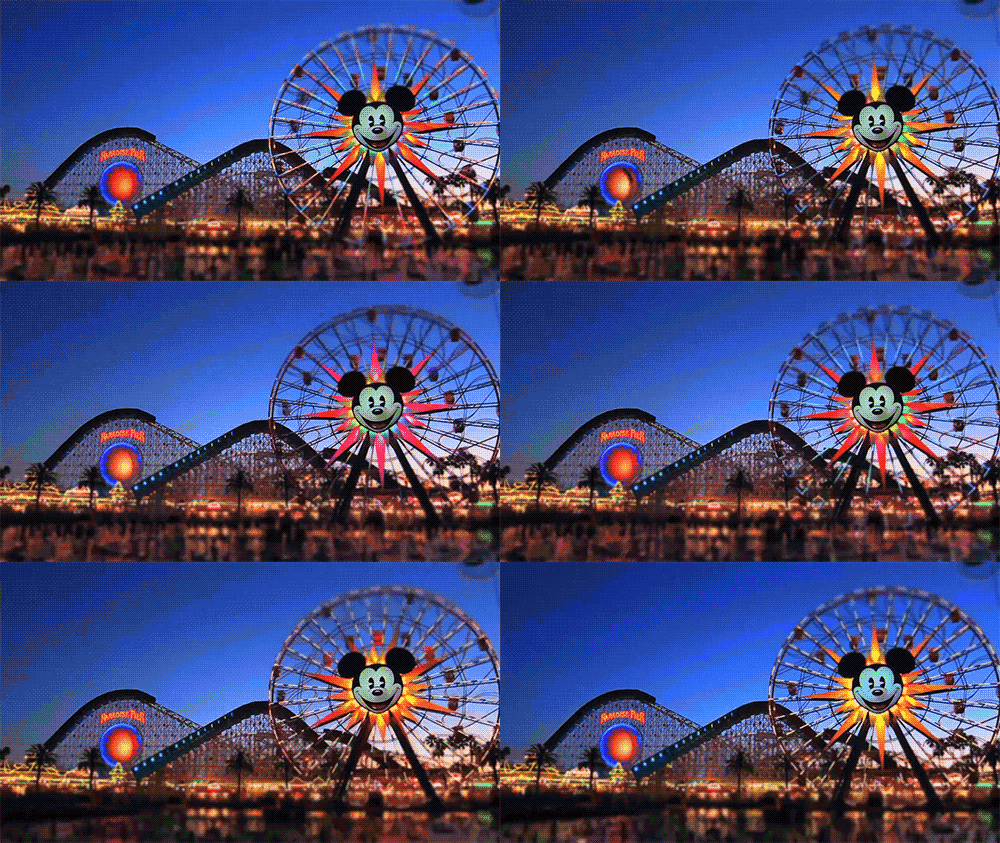
On a business trip to Chicago in the late-1940s, Disney drew sketches of his ideas for an amusement park where he envisioned his employees spending time with their children. The idea for a children's theme park came after a visit to Children's Fairyland in Oakland, California. It also said that Disney may have been inspired to create Disneyland in the park Republic of the Children located in Manuel B. Gonnet, La Plata, Argentina, and opened in 1951. This plan was originally intended to be built on a plot located across the street to the south of the studio. These original ideas developed into a concept for a larger enterprise that would become Disneyland. Disney spent five years developing Disneyland and created a new subsidiary company, WED Enterprises, to carry out planning and production of the park. A small group of Disney studio employees joined the Disneyland development project as engineers and planners, and were dubbedImagineers.
As Disney explained one of his earliest plans to Herbert Ryman, who created the first aerial drawing of Disneyland presented to the Bank of America during fund raising for the project, he said, "Herbie, I just want it to look like nothing else in the world. And it should be surrounded by a train." According to Disney's own account, entertaining his daughters and their friends on the Carolwood Pacific Railroad inspired him to include a railroad in Disneyland.
Walt Disney Productions began work on Disneyland, as well as expanding its other entertainment operations. In 1950,Treasure Island became the studio's first all-live-action feature, soon followed by 20,000 Leagues Under the Sea (inCinemaScope, 1954), Old Yeller (1957), The Shaggy Dog (1959), Pollyanna (1960), Swiss Family Robinson (1960), The Absent-Minded Professor (1961), and The Parent Trap (1961). The studio produced its first TV special, One Hour in Wonderland, in 1950. Disney began hosting a weekly anthology series on ABC entitled Disneyland, after the park, on which he aired clips of past Disney productions, gave tours of his studio, and familiarized the public with Disneyland as it was being constructed in Anaheim. The show also featured a Davy Crockett miniseries, which started the "Davy Crockett craze" among American youth, during which millions of coonskin caps and other Crockett memorabilia were sold across the country. In 1955, the studio's first daily television show, Mickey Mouse Club debuted on ABC. It was a groundbreaking comedy/variety show catered specifically for children. Disney took a strong personal interest in the show and even returned to the animation studio to voice Mickey Mouse in its animated segments during its original 1955–59 production run. The Mickey Mouse Club continued in various incarnations in syndication and on the Disney Channel into the 1990s.
As the studio expanded and diversified into other media, Disney devoted less attention to the animation department, entrusting most of its operations to his key animators, whom he dubbed the Nine Old Men. Although he was spending less time supervising the production of the animated films, he was always present at story meetings. During Disney's lifetime, the animation department created the successful Lady and the Tramp (the first animated film in CinemaScope) in 1955, Sleeping Beauty (the first animated film in Super Technirama 70mm) in 1959, One Hundred and One Dalmatians (the first animated feature film to use Xerox cels) in 1961, and The Sword in the Stone in 1963.
Production of short cartoons kept pace until 1956, when Disney shut down the responsible division though special shorts projects continued for the remainder of the studio's duration on an irregular basis. These productions were all distributed by Disney's new subsidiary, Buena Vista Distribution, which had taken over all distribution duties for Disney films from RKO by 1955. Disneyland, one of the world's first theme parks, finally opened on July 17, 1955, and was immediately successful. Visitors from around the world came to visit Disneyland, which contained attractions based on a number of successful Disney characters and films.
After 1955, the Disneyland TV show was renamed Walt Disney Presents. It switched from black-and-white to color in 1961 and changed its name to Walt Disney's Wonderful World of Color, at the same time moving from ABC to NBC, and eventually evolving into its current form as The Wonderful World of Disney.Since then, it has aired on ABC,CBS, NBC, the Hallmark Channel and the Cartoon Network via separate broadcast rights deals. During its run, the Disney series offered some recurring characters, such as the newspaper reporter and sleuth "Gallegher" played by Roger Mobley with a plot based on the writings of Richard Harding Davis.
Disney had already formed his own music publishing division in 1949 and in 1956. Partly inspired by the huge success of the television theme song The Ballad of Davy Crockett, he created a company-owned record production and distribution entity called Disneyland Records.
Disney Animation-
Walt Disney was a pioneer in character animation. He was one of the first people to move animation away from basic cartoons with just "impossible outlandish gags" and crudely drawn characters, and towards elevating the field into an art form with heartwarming stories and characters the audience could connect to on an emotional level. As noted above, this culminated in his creation of a separate story department where storyboard artists would specialize in story development. The personality displayed in the characters of his films as well as the great technological advancements they represented remain influential today. He was considered by many of his colleagues to be a master storyteller and the animation department did not fully recover from his death until the period from 1989 to 1999 which is now known as the Disney Renaissance. The most financially and critically successful films produced during this time include Who Framed Roger Rabbit (1988), The Little Mermaid (1989), Beauty and the Beast (1991), Aladdin (1992) and The Lion King (1994). In 1995, Walt Disney Pictures distributed Pixar's Toy Story, the first computer animated feature film. Walt Disney's nephew Roy E. Disney claimed that Walt would have loved Toy Story and that it was "his kind of movie".
With the rise of computer animated films a stream of financially unsuccessful traditional hand-drawn animated features in the early years of the 2000s (decade) emerged. This led to the company's controversial decision to close the traditional animation department. The two satellite studios in Paris and Orlando were closed, and the main studio in Burbank was converted to a computer animation production facility, firing hundreds of people in the process. In 2004, Disney released what was announced as their final "traditionally animated" feature film, Home on the Range. However, since the 2006 acquisition of Pixar, and the resulting rise of John Lasseter to chief creative officer at Disney Animation, that position has changed with the largely successful 2009 film The Princess and the Frog. This marked Disney's return to traditional hand-drawn animation, as the studio hired back staff who had been laid-off in the past. Today, Disney produces both traditional and computer animation.
Abt site- Walter Elias "Walt" Disney was an American business magnate, cartoonist, filmmaker, philanthropist, and voice actor. As a prominent figure within the American animation industry and throughout the world, he is regarded as a cultural icon.